

What Are Psychosocial Hazards?
Understanding Risks, Responsibilities, and Resilience in Asian Workplaces
Psychosocial hazards are emerging as one of the most critical workplace health and safety concerns across Asia. Unlike physical hazards that are easily visible, psychosocial hazards often remain hidden beneath the surface of workplace culture, management practices, and interpersonal dynamics. Left unmanaged, these risks can lead to significant harm for employees and costly impacts for organisations.
This article explores the prevalence of psychosocial hazards in Asia, their impact on workers and organisations, the legal obligations faced by employers, and the risk management process required to build healthier, safer, and more resilient workplaces.
Prevalence of Psychosocial Hazards in Asia
Across Asia, the prevalence of psychosocial hazards varies by country and regulatory landscape, but the trend is consistent: workplace mental health is a growing concern.
-
Singapore: The Ministry of Manpower (MOM) and Workplace Safety and Health (WSH) Council have increasingly focused on mental well-being as part of safety frameworks. Surveys show stress and workload pressures remain leading concerns for employees.
-
Australia & New Zealand (for Asia-Pacific comparison): Regulators like Safe Work Australia and WorkSafe New Zealand explicitly recognise psychosocial hazards under WHS legislation, setting a high benchmark for regional compliance.
-
Japan: With the “Karoshi” (death by overwork) phenomenon, regulators mandate stress checks and interventions to prevent overwork-related illness.
-
China: Rapid industrialisation and long working hours contribute to burnout and presenteeism, with regulators starting to address psychosocial risks.
-
India & Southeast Asia: Growing recognition of workplace stress, harassment, and inequity, but regulations remain inconsistent and enforcement uneven.
Over 60% of workers in Asia report experiencing significant work-related stress — the highest regional figure globally (ILO, 2023).
Impact of Psychosocial Hazards on Worker Health and Safety
Psychological Effects
Exposure to psychosocial hazards — such as excessive workloads, bullying, job insecurity, or poor management support — can lead to anxiety, depression, burnout, and reduced emotional resilience. Over time, these conditions may escalate into chronic mental health disorders.
Physical Health Consequences
Stress-related illness manifests not only psychologically but also physically. Workers may experience cardiovascular issues, fatigue, sleep disturbances, weakened immune systems, and even increased susceptibility to workplace accidents.
Organisational Impacts
Unmanaged psychosocial hazards lead to absenteeism, presenteeism (being at work but unproductive), high turnover, reduced morale, and reputational damage. Financially, the costs are significant — lost productivity due to mental health issues is estimated at billions of dollars annually across Asia.

Legal Obligations for Managing Psychosocial Hazards
Employers across Asia have an evolving but clear duty of care to manage psychosocial risks, just as they would physical risks.
-
Singapore: The WSH Act requires employers to provide a safe workplace, which increasingly extends to psychological safety.
-
Australia & New Zealand: Legislation explicitly identifies psychosocial hazards as workplace health and safety issues, with penalties for non-compliance.
-
Japan: Mandatory workplace stress checks for organisations with 50+ employees.
-
China, India, ASEAN nations: Broader labour laws are beginning to incorporate mental health protections, though enforcement varies.
Call-out Box Idea:
Legal frameworks across Asia are converging on one key message: psychological health is a workplace safety issue.
The Psychosocial Risk Management Process
Effectively addressing psychosocial hazards requires a structured approach, often aligned with ISO 45003: Psychological Health and Safety at Work.
1. Identifying Psychosocial Hazards in the Workplace
Conduct surveys, focus groups, and risk assessments to detect sources of stress — such as workload, role ambiguity, workplace bullying, or lack of autonomy.
2. Assessing Psychosocial Risks
Evaluate the likelihood and potential severity of harm from identified hazards. Prioritise risks that could cause significant harm to employee well-being.
3. Controlling Psychosocial Hazards
Implement controls such as workload management, leadership training, flexible work policies, anti-bullying procedures, and access to Employee Assistance Programs (EAPs).
4. Reviewing Control Measures
Regularly monitor and evaluate the effectiveness of interventions. Use employee feedback and data to refine and strengthen controls.
Visual Suggestion:
A four-step flowchart showing the cycle of hazard identification → risk assessment → control measures → review.
Build a Resilient Organisation With a Stronger Bottom Line
Proactively managing psychosocial hazards is not just about compliance — it’s about resilience. Organisations that safeguard psychological health foster higher engagement, stronger performance, and greater loyalty.
When employees feel safe, supported, and valued, the organisation benefits from:
-
Increased productivity and innovation.
-
Lower absenteeism and turnover.
-
Stronger employer brand and talent attraction.
-
Sustainable profitability and growth.
A Thought:
In Asia’s fast-changing business environment, the organisations that thrive will be those that treat psychological health and safety not as a cost, but as an investment in people and performance.
Preventing psychosocial harm is therefore not just a legal obligation but also makes good business sense.
The Psychosocial Risk Management Process
Managing psychosocial hazards at work requires a proactive, systematic approach based on the principles of risk management.
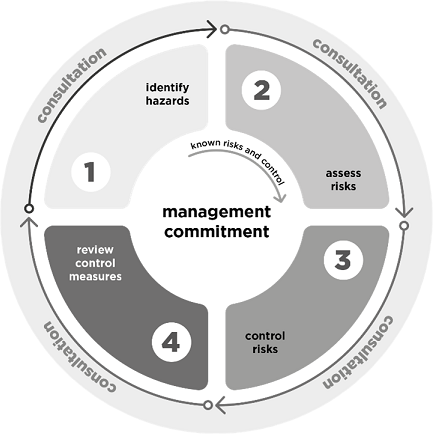
(Source: Safe Work Australia)
1. Identifying Psychosocial Hazards in the Workplace
Identifying psychosocial hazards is the critical first step in protecting worker mental health. It involves finding aspects of work and the work environment that could cause psychological harm.
Key risk factors to consider include:
Job Content
- High workloads and time pressure
- Lack of variety in work tasks
- Emotionally demanding work (e.g. dealing with difficult clients)
- Exposure to traumatic events or distressing information
Work Environment
- Poor physical working conditions (e.g. noise, overcrowding)
- Isolated work with lack of social support
- Violent or threatening situations
- Lack of resources and equipment to do the job
- Unclear roles and responsibilities
Work Organisation
- Lack of control over workload and work methods
- Inflexible or unpredictable work schedules
- Lack of participation in decision-making
- Poor organisational change management
- Job insecurity and precarious employment
Social and Relational Factors
- Bullying, harassment, and discrimination
- Interpersonal conflict and poor workplace relationships
- Lack of social support
- Unfair treatment and lack of recognition
2. Assessing Psychosocial Risks
Once psychosocial hazards have been identified, the next step is to assess their associated risks.
Risk assessment involves considering the severity of the potential harm from a hazard and the likelihood of that harm occurring. This information is then used to prioritise risks and inform the selection of appropriate control measures.
When assessing psychosocial risks, consider the following:
Severity of Harm
Psychosocial hazards can lead to harm ranging from mild stress symptoms to severe mental health disorders. The assessment needs to consider how serious the potential harm could be, based on factors like:
- The nature of the hazard (e.g. bullying vs tight deadlines)
- Intensity, frequency and duration of exposure
- Interaction between multiple hazards (e.g. high demands coupled with low control)
Likelihood of Harm
Consider how likely the hazard is to cause harm, based on:
- Number of workers exposed
- Frequency and duration of exposure
- Existing control measures and their effectiveness
Other Factors
The risk assessment should also examine broader factors that could influence the risk, such as:
- Vulnerable workers (e.g. young, new or isolated workers, those with existing mental health conditions)
- Industry and occupational risk factors (e.g. high risk industries like healthcare)
- Organisational climate, culture, and perceptions of organisational justice
A comprehensive risk assessment provides vital information for targeting interventions to where they are needed most. Our consultants have deep expertise in inclusive, culturally competent risk assessment processes.
3. Controlling Psychosocial Hazards
Once psychosocial risks have been identified and assessed, the next step is to implement control measures to eliminate or minimise those risks.
This requires organisations to apply the hierarchy of controls when managing risks:
Elimination
Where possible, removing the psychosocial hazard completely is the most effective control. Examples could include:
- Redesigning jobs to remove boring, repetitive, or aversive tasks
- Automating processes to reduce workload and time pressure
- Transferring aggressive clients to specialised services better equipped to meet their needs
Substitution
Substitution involves replacing a psychosocial hazard with a safer alternative, such as:
- Rotating workers between emotionally demanding tasks and more neutral duties
- Allowing flexible work arrangements to give workers more control over their schedules
- Using positive performance feedback to motivate staff instead of punitive monitoring
Engineering Controls
Engineering controls are physical changes to the work environment that reduce psychosocial risks, like:
- Providing quiet spaces for workers to take breaks and unwind
- Improving lighting, ventilation and ergonomics to create a more pleasant work environment
- Installing duress alarms and CCTV to deter violence and aggression
Administrative Controls
Administrative controls are policies and procedures that aim to minimise psychosocial hazards. These could include:
- Setting clear expectations around respectful workplace behaviour
- Providing training on dealing with difficult customers, time management, and resilience skills
- Ensuring adequate staffing levels to manage workloads
- Developing lone worker check-in systems and emergency response plans
- Offering employee assistance programs with counselling support
Personal Protective Equipment
PPE is the least effective control for psychosocial risks but may be needed in some high-risk situations to protect workers’ physical safety (e.g. body armour, personal distress alarms).
In practice, a combination of control measures is often required to effectively manage psychosocial hazards. Interventions should be selected based on the specific risk factors identified and the needs of the workforce. Worker participation is key to designing controls that will be effective and acceptable to those impacted.
4. Reviewing Control Measures
Finally, organisations must monitor and review their control measures to ensure they are effective in managing psychosocial risks over time. Regular review processes can identify:
- If controls are being implemented as intended
- Whether controls are effective in minimising risks
- Any new hazards that have emerged
- Opportunities for continuous improvement
Reviewing controls should involve ongoing worker consultation, analysis of organisational data, and re-assessment of risks. Diversity New Zealand can help your organisation establish robust review processes and identify areas for enhancement. Reach out to us here for support.
Build a Resilient Organisation With Stronger Bottom Line
Psychosocial hazards are a serious but often overlooked risk to worker health and safety. The human and financial costs of work-related stress are significant and likely to increase in the face of ongoing economic uncertainty and change.
The good news is that creating a mentally healthy workplace is not only the right thing to do, but also benefits the bottom line through increased productivity, reduced turnover, and enhanced reputation.
With over 10 years of experience we are committed to helping your organisation realise these benefits. Our expertise in DEI consulting and training, psychosocial risk assessment, and strategy development can support you in building a workplace where everyone can flourish.
Contact us today to find out how we can assist your organisation. Together, we can empower your workforce, navigate psychosocial challenges, and foster an environment of equity and inclusion.